
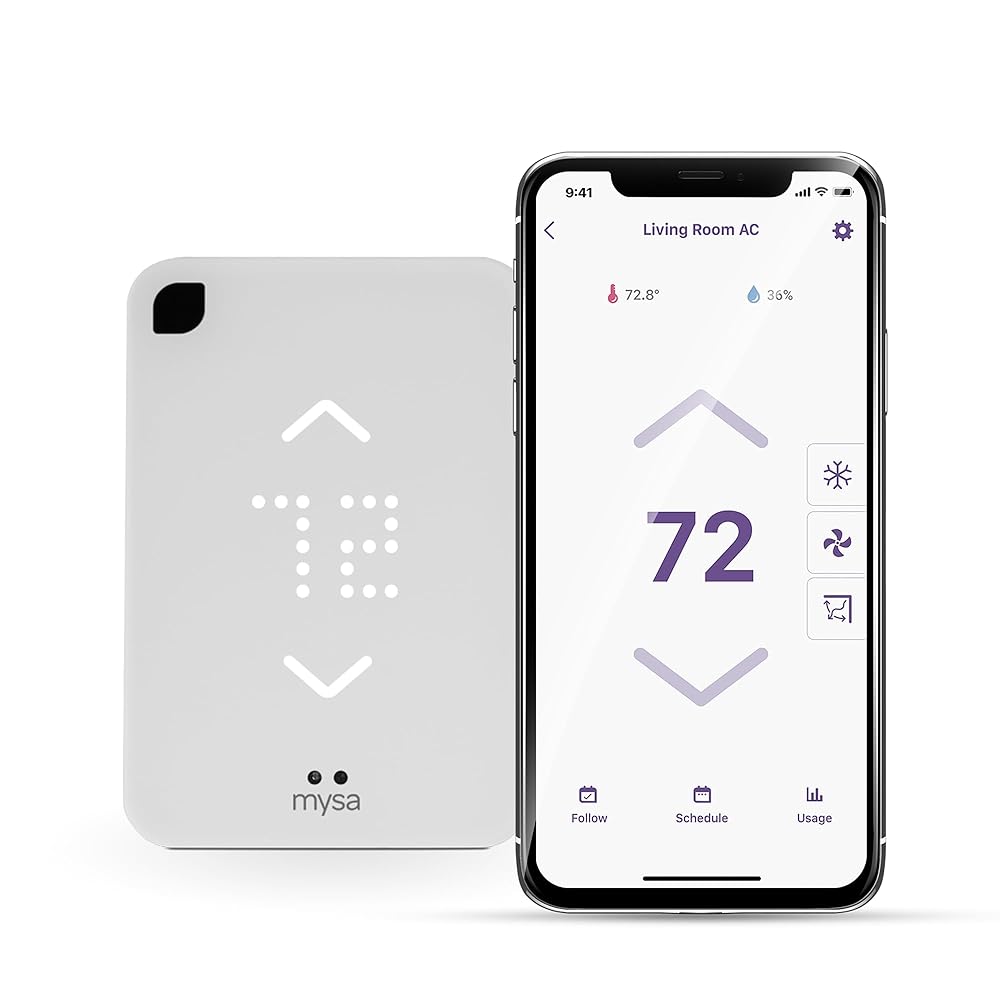
- Make Your Mini-Split Heat Pump & AC Smart. Now with a newly designed wall mount.
- Premium Remote Control with Free App – monitor and adjust your home heating with your phone. No hidden fees, and no gated features. Now with even more remote control functions.
- Save on energy costs with easy app features. Use Mysa’s in-app Schedules, Geofencing, and more to customize home heating or cooling to fit your routines and help you lower your monthly electricity bill.
- You could save even more with a smart thermostat rebate from your utility provider. Contact Mysa to check your eligibility.
- Smart Alerts for Your Comfort and Safety – Mysa’s exclusive Climate+ feature and Filter Cleaning Alerts keep you perfectly cozy and breathing easy.
- Voice Control – use Mysa’s smart home integrations with HomeKit, Alexa, and Google Home to automate your home and make your life easier.
- Setup With Confidence – Mysa’s easy-to-follow, step-by-step video guidance and expert Support team make setting up your Mysa a breeze.
- Superior Wi-Fi Connectivity – Mysa is designed for 2.4 GHz Wi-Fi networks to maximize signal strength. Also works with combined 2.4 and 5 GHz networks, and MESH Wi-Fi networks.
- Premium Hardware and Setup Options – enjoy Mysa’s sleek, modern design and at-unit touch temperature control. Use the secure wall mount or choose tabletop setup for extra convenience and mobility.
- Designed in Canada – Mysa is engineered for North American climate conditions, with rigorous cybersecurity standards. Your home stays cozy and secure.
| Brand | Mysa |
|---|---|
| Model Name | Mysa AC |
| Product Dimensions | 2.87"D x 5.59"W x 6.65"H |
| Controller Type | Amazon Alexa |
| Special Feature | DIY Set Up, Table Top or Wall Mount, Energy Insights, Home Environment Alerts, Geofencing. |
| Color | White |
| Specific Uses For Product | For ductless mini-split heat pumps, portable and window AC units |
| Temperature Control Type | Cooling and Heating |
| Connectivity Technology | WiFi, NFC |
| Included Components | 1 x Mysa Smart Controller for Mini-Splits + AC, 1 x Welcome Booklet, 1 x Mini-Split, AC Power Adapter, 1 x Micro USB Cable, 2 x Mounting Screws, 2 x Adhesive Wire Ties, 1 x Tabletop Stand |
| Power Source | Corded Electric |
| Item Weight | 9.9 ounces |
| Voltage | 24 Volts |
| Shape | Rectangular |
| Display Type | LED |
| Screen Size | 3 Inches |
| Control Type | App Control |
| Control Method | Voice |
| Connectivity Protocol | Wi-Fi |
| Mounting Type | Wall Mount |
| Style | Minimalist |
| Backlight | Yes |
| UPC | 821661307129 |
| Manufacturer | Empowered Homes Inc. |
| Country of Origin | China |
| Item model number | MYSA AC V1-0 |
| Date First Available | June 14, 2021 |
10 reviews for Mysa Smart Thermostat for Mini-Split Heat Pumps & AC | Smart Controller Replaces Remote | Control with 100% Free App | No Subscription | Easy Setup | HomeKit, Alexa, Google Home…
Add a review
Related products
Sale!
Split-System Air Conditioners

Split-System Air Conditioners
KWIK-E-VAC Line Set Flushing Kit Installation Simplifier for Mini Split Air Conditioning Systems
Split-System Air Conditioners
3 TON 15 SEER2 HEAT PUMP SYSTEM AIR HANDLE, CONDENSER, HEAT STRIP
$2,895.00
Split-System Air Conditioners
18k BTU 21.5 SEER MrCool Olympus Hyper Heat Ductless Heat Pump Split System – Wall Mounted
$1,724.51
Sale!

Split-System Air Conditioners
Original price was: $3,078.00.$2,931.00Current price is: $2,931.00.
Split-System Air Conditioners
D. DEGEORGE –
Mysa has a rich set of features that work well and should please home-automation & IoT buffs and people who are often away from home. Its integration with electronic assistants—my experience is with Alexa and Google—is impressive, although not complete. It is evident that a lot of thought was put into its design, and the thermostat itself is good-looking. In addition, its developers are active in adding improvements, some available through firmware updates. Technical support has been thorough and responsive, except for my very first contact with them, in which I got a perfunctory answer.
The setup process, while generally well-designed and documented, did hit a couple of brief snags, but nothing for which I had to contact technical support initially; I did have to do a few of the steps a second time, which was mildly annoying, but no big deal. Part of the process involves discovering a “code set” that most nearly matches that of the native remote for the target HVAC. (Mysa works by impersonating the native remote. More on this below.) It’s a trial-and-error process similar to training a home-theater universal remote to take over the functions of various native remote controls; you know, the process where you go through a series of steps until you find the code that operates the on-off switch, for example. In the case of Mysa and my heat pump, I reached a successful code set but later learned that it was not optimum. For my money, I’d prefer that Mysa included a comprehensive list of appropriate codes for all the devices with which it is compatible, which one could enter directly, but I understand that the popular trend is to keep the setup process simple and interactive, and the latter is the approach Mysa takes.
I did not run into any of the WiFi issues reported by other users here.
I especially appreciate the graphs provided in the app, which show a history of room temperature, humidity, and set points (target temperatures). I can review what happened overnight, for example, and compare the effects of the various settings so that I can choose better settings for the future; I also used these to compare performance with and without Mysa in control of the HVAC.
As I said above, Mysa takes over from the heat pump’s native remote control. What, you might ask, is the point of that? Well, for one thing, the Mysa app is simplified, and by virtue of that, more elegant than the cluttered hieroglyphics of the native remote. However, Mysa doesn’t have all the functions of the native remote, so it’s a tradeoff. On the other hand, the thing that the Mysa remote can do that the native remotes cannot is to be operated over the Internet; and while I suggested that this function would be of interest primarily to people who are out of their houses a lot, I’ve found it quite handy even when I’m home. I live in a fairly large house, and it’s quite nice to be able to control the thermostat from my smartphone or any of the several Google and Alexa devices scattered throughout the house, by voice command in many cases. Mysa is also helpful in sending an alert to the smartphone when a temperature goes out of bounds. But why would one want/need to have such frequent interaction with a thermostat, especially while at home? That’s the rub, and the reason it was somewhat generous of me to give the product four stars. Read on:
Mysa is almost, if not entirely, unique in trying to overcome the deficiency of many heat-pump mini-split units, namely that the latter’s thermostats are wildly inaccurate. Part of the reason for this is that the native thermostats are part of the HVAC units. As soon as the unit begins to heat up (or cool down, depending upon the season), the thermostat makes the false assumption that the room has reached the target temperature and shuts down. With this design, the temperature swings are as great as +/- 7 degrees, and occasionally worse (in my experience thus far). The first step in addressing this issue is to have the thermostat external to the heat pump, a condition that Mysa provides by its very nature. Mysa tries to take it a step further with its Comfort+ feature. Sadly, this feature is grossly inadequate to solve the problem, because of the obstreperousness of some mini-splits. You see, some very popular brands of mini-splits, including mine, don’t use a simple on-off-type of thermostatic control like most A/Cs and furnaces I’m used to, but instead a system based upon temperature targets, in which one sets the desired temperature and lets the unit itself (not the thermostat) “decide” when to turn on or off and how strongly to heat/cool, regulate the fan, etc. in pursuit of the target temperature. Thus, external thermostats such as Mysa are only given the option of sending a target temperature to the unit and hoping for the best. The results are wildly unpredictable. This is where Mysa’s Comfort+ feature comes in. Sensing the difference between the actual room temperature and the thermostat setting, Mysa “nudges” the mini-split to a higher or lower temperature as appropriate. For example, if the target temperature sent to the unit is 70 degrees, but the actual room temperature has settled into 64 degrees, Mysa may send the unit a request for 75 degrees, “assuming” that the end result would be a room temperature of the desired 70 degrees. The problem is that Mysa currently limits itself to nudges of about 5 degrees Fahrenheit, max. This is not enough to deal with the wild inaccuracy of some mini-splits. Mysa engineers are afraid that if Mysa tries to “fool” the target units too much, it could damage the units. Mysa’s developers are aware of this shortcoming and say that they are working on it, which is encouraging, but for now, I’d have to say that the Comfort+ feature is only about 25% successful (to put a number on a very subjective perception). When the weather is mild and the heat-pump doesn’t have to work too hard, Comfort+ works reasonably well, maintaining a very steady temperature, much steadier than the unit would have on its own (I’ve tested my unit both with the native remote control and the Mysa). But under weather conditions that are the least bit challenging, the process breaks down, and chaos rules again. This behavior was the reason that I called product support. I hoped that there was a better code set than the one that resulted from the initial setup, and indeed tech support identified one, which I applied. It didn’t solve the problem, though.
[My comments are based upon my experiences with Mysa and an FS-series Mitsubishi split-type AC/heat-pump during the winter, with outside temperatures ranging between nighttime lows of 20 to daytime highs of 60, in a sunroom that is mostly glassed-in on 3 sides. Admittedly, this is one of the more challenging environments for the equipment. Nevertheless, the mini-split seems to have the capacity to heat the room adequately, but it seems not to “want to”—it requires prodding by the user’s requesting much higher temperatures than actually desired, and then backing off when outdoor temperatures rise. So it requires constant attention, which runs counter to the whole purpose of thermostats.]
Because of the inability of Mysa in combination with the mini-split to achieve and maintain a target temperature, the user has no choice but to monitor the situation rather closely, especially if a minimum temperature is required during winter for the sake of plants in a mostly unoccupied room. That’s where the ability to monitor and control the mini-split remotely comes in handy.
Mysa’s product support suggested that perhaps one could exercise additional automated control through the use of home assistants such as Alexa and Google. These assistants can monitor temperature through Mysa and can also send controls to Mysa. Regrettably, these two capabilities cannot currently be married by an Alexa or Google routine to send Mysa an action based on the temperatures it reports. If such a capability existed (and maybe it will someday), a user might be able to solve the problem that Comfort+ is too cautious to fix. Take the following for example: Alexa sees that while the thermostat is set to 70 degrees, the actual temperature is 55. Then, as specified by the user, Alexa could send a command to Mysa to set the temperature to 85, with the intent of bringing the temperature up to 70. If actions of Mysa could be made contingent upon conditions reported from Mysa, the user could finally get control over the troublesome mini-splits. Unfortunately, we are not yet at that point.
In view of the above, I strongly advise potential customers whose #1 reason for buying Mysa is to tame troublesome mini-splits, that it’s probably not going to work—at least not as of this writing in early 2024. Mysa can still be a partial solution, but understand that it’s going to require a lot of supervision to achieve the desired result. I was disappointed and came very near to returning the unit, but in the end, I considered its virtues to outweigh its one very significant deficiency, enough to justify its friendly price.
madkiwi –
I have been fighting with this tech garbage for 3 weeks, it’s going back to Amazon. I am trying to integrate this with a Mitusbishi Electric mini-split heat pump, air handler is a FS model. One of the most popular heat pumps in the world.
First off the app/thermostat has a very limited set of instructions, so no matter how fancy your factory remote is this thermostat cannot do half of the commands. But as bad as that sounds, it gets worse! It will randomly “turn on” features Mysa claims the thermostat can’t control. It turns on the I-see IR sensor on the head unit, even though the functions the sensor is used for cannot be enabled by Mysa. It also sets the left-right sweep of the air handler to “far left”. If I use the Mitsubishi remote to turn off the I-see sensor or set the sweep back to center the next time I come back the vanes will be pointed left again and the I-see sensor will be rotating back and forth. Mysa claims the thermostat does not control left-right sweep, only up and down and doesn’t do anything with the I-see sensor. Oh really?
The schedule does whatever the heck it wants. I might THINK I have it set to turn heat up to 72 F at 5:30 pm, but screw you! Tonight I opened the app at 7 pm and it informed me it was on hold until 11 pm at 63 F. I did not press any buttons on the thermostat or open the app and manually override the schedule. Did I mention this happens at least 6-8 times a week? Mysa considers your schedule as optional suggestions, but not gonna happen.
Communicating with Mysa tech support is “interesting”. They tried to suggest the missed schedule changes are due to the conversions from Celsius to Fahrenheit not being whole numbers. They suggested I try setting the thermostat to 41, 50, 59, 68, 77, or 86 F, because those temps convert to whole Celsius temps… Considering that a Mistubishi heat pump will not go lower than 61 that leaves 68, 77 or 86 F. I’m in Montana, it’s winter, if I want 86 F I should just go to Tahiti.
As for the thermostat randomly turning on features (that they say the Mysa does not address) they are not going to research it because “it isn’t a widespread problem”. I am not asking them to control those features, I am telling them their IR emitter is sending some extra commands that it should not do and they should figure out why.
I am not interested in being a beta tester for a product that just is not reliable or predictable. So back into the box it goes, to be dropped at a UPS store.
John T. Marquis –
Although it took 3 tries on the two thermostats I installed for my mini split air conditioners, once I got them successfully (software) updated, they were a breeze to set up. They work amazingly well! One downside is the large wire that protrudes from the back (the AC power cord). If I hang the thermostat, I have a large white wire running down the wall to an AC outlet. But it comes with a stand so I placed it on an end table, hiding the cord behind the table. Overall, great product! I would highly recommend them!!
David –
I used the setup to pair with my Moovair heat pump. Moovair is not on the list but managed to get most features working using the learning mode. The louver sweep function doesn’t work however so I am hoping some day they will add Moovair official support.
I was getting bizarre settings with the displays on the Moovair, the remote, and the app all showing different temperatures. I finally figured out it was the Climate+ feature trying ti do its thing (unsuccessfully). I turned off Climate+ and now it works as expected. I like the ability to control from Alexa or from my app when away from home.
Amazon Customer –
Great customer support! I needed some help setting up the remote and I got quick and clear instructions from tech support. The thermostat works as advertised and is very stable on HomeKit. I am happy with my purchase.
Amir –
Love this AC thermostat. It works great and looks beautiful. I am using it with a minisplit.
They Improvement it needs to be rechargable cordless.
C. Beers –
When I got my mini splits installed, the installer told me that they are controlled through remotes which seemed odd for such a major device. He asked, “well how else would you want to control them?” Umm, a thermostat that can be mounted so I don’t need to babysit these things all day. He said he didn’t think that was possible. Are you kidding me? Then came this and it was like they read my mind. Everything about this product experience has been flawless. The initial setup, the documentation, and finally the reliability of the service and the device JUST WORKS! What a breath of fresh air. I bought a second to control the other mini split upstairs. I love the fact that it remotely controls all the features but mounted on a wall. It just makes sense and has started saving me money. This is a great company. Keep up the great products.
Fraser –
I’ve had this for half a year, it’s worked flawlessly in Apple Homekit with my Mitsubishi Mini Spit; however, the temperature readings cannot be calibrated whatsoever which in a thermostat is critically important and practically renders it useless. Many other brands can be calibrated but Mysa refuses to address this frustration despite several hundreds of complaints online. I’ve taken mine out and replaced with another brand. The hardware is great, the software is easy to use, the connection is stable but the product is absolute junk because the temperature readings are always wildly incorrect. Until they add a manual temperature calibration, consider this as junk.
Gerry –
Easy to install and a Jem to use especially from outside the home, love it
Cory –
Perfect